
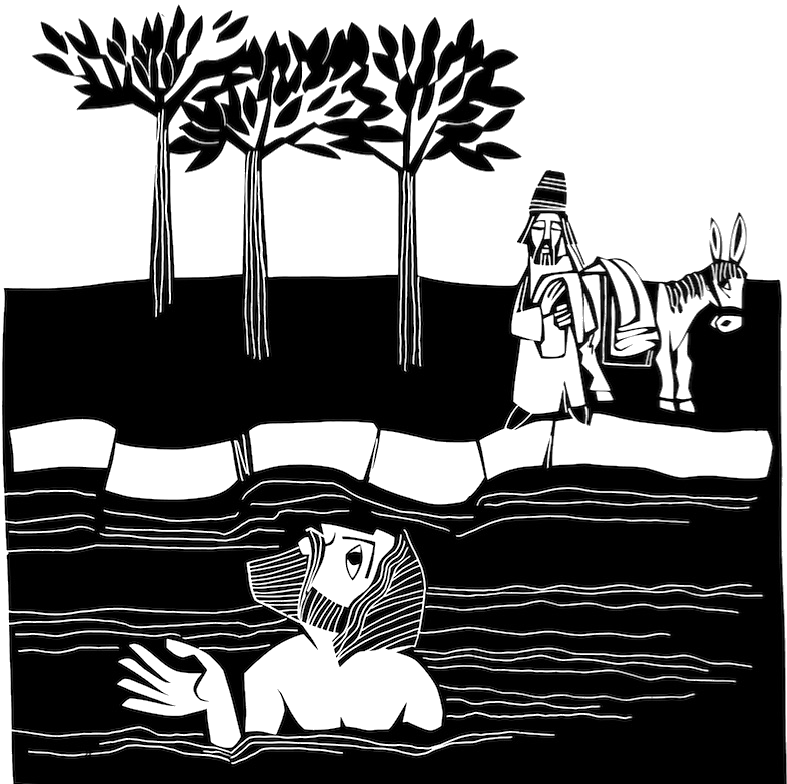
I wonder what happened to the nine lepers who did not go back to thank Jesus. Did their minds immediately turn to other needs, newer preoccupations, more urgent petitions? Did they just move on with their lives, now cured of leprosy but worried about something else? Did they remember how it was when they always kept a distance and ever longed for cleansing?
Maybe, if they had kept a journal of those days, they could have turned back the pages to forgotten times when they cried out for pity or begged for help. They might have remembered how they once thought their whole world would be charged with light if they could be healed, like Naaman, with their skin as fresh as a child’s. They could have compared their old feelings about their affliction and their new freedom, having now won their hearts’ desire.
There are times when we seem to go through life the way some children go through birthday presents. We tear through the wrapping paper of our gifts, piling up the boxes as we move on to the next bright toy. Perhaps we shake an envelope without reading the message or knowing who it is from. What’s next? Is that all?
This perpetual flitting of our interest, this inability to rest in the gift, occurs also in matters of health. We might fret through a night, thinking the heartburn is heart attack, the cold sore is cancer, the next day is treacherous. In a matter of hours, the jeopardy may pass, and we forget the gift as we begin to brood over something else.
So it is with our desires. If only I might be married. If only we might have a child. If only I could change my job.
Why is it we charge through life so unaware of our million deliverances? Do we appreciate our rescues or healings even a tenth of the time? If we could count the fears, both small or large, that once hounded us, and then thank God for each dreaded outcome never met, we would reach no end to gratitude.
We will not take full possession of our lives until we learn to give thanks for them. We don’t really own our legs or eyes, our hands and skin unless we’re daily grateful. We don’t really live with our loved ones unless we foster an appreciative, almost contemplative sensitivity to their presence. It is only the loss of them—or the threat of it—that shakes us into an awareness of their manifold grace.
But when we wake up from our sleepwalk, when we see the wonder of the smallest parts of our existence, we begin to live. It is then we know what it is like, with the tenth leper, to be saved.
Perhaps the most grateful person I’ve ever heard of was an old woman in an extended care hospital. She had some kind of wasting disease, her different powers fading away over the march of months. A student of mine happened upon her on a coincidental visit. The student kept going back, drawn by the strange force of the woman’s joy. Though she could no longer move her arms and legs, she would say, “I’m just so happy I can move my neck.” When she could no longer move her neck, she would say, “I’m just so glad I can hear and see.”
When the young student finally asked the old woman what would happen if she lost her sense of sound and sight, the gentle lady said, “I’ll just be so grateful that you come to visit.” There was an uncommon freedom in that student’s eyes as she told me of her friend. Somehow a great enemy had been disarmed in her life.
Gratitude not only empowers the receiver of the gift; it confirms the giver. “You really believe I love you,” the giver says in the heart.
It is truly wondrous when others actually believe you love them. It is glorious when someone thanks you.
Might God be more interested in our gratitude than anything else? Was the primal sin ingratitude?
The healed leper, Naaman, proclaimed to Elisha, “Now I know there is no God in all the earth, except in Israel.” How God must have delighted.
And Christ, having healed ten, saw something greater in the one Samaritan who made time to come back, fall at his feet, and praise God. He saw the splendor of a human heart that believes it is loved, that accepts the gift. Such faith not only brings salvation. It is the gift back to God, so enchanting that God would die for love of it.
The invitation was to a graduation for Licensed Practical Nurses. Somehow, stronger than all the threat of violence and abuse, more appealing than any seduction of the moment, was the gift and promise of a person’s witness.
The good is like a frail fire. It expends itself once it is lit, bringing light to those around. Even though slight, it can illuminate a big dark room, helping you make it to the other side. Like love and wisdom, it lives in being communicated, being given.
My midwife-sister-friend did that for a young girl. She did that for me. You just do not know how faith bears fruit. You just do not know how love lives anew.
I remind you to stir into flame the gift of God bestowed when my hands were laid on you. The Spirit God has given us is no cowardly spirit, but rather one that makes us strong, loving and wise. Therefore, never be ashamed of your testimony to our Lord … but with the strength that comes from God, bear your share of hardship which the Gospel entails (Second Reading)


