
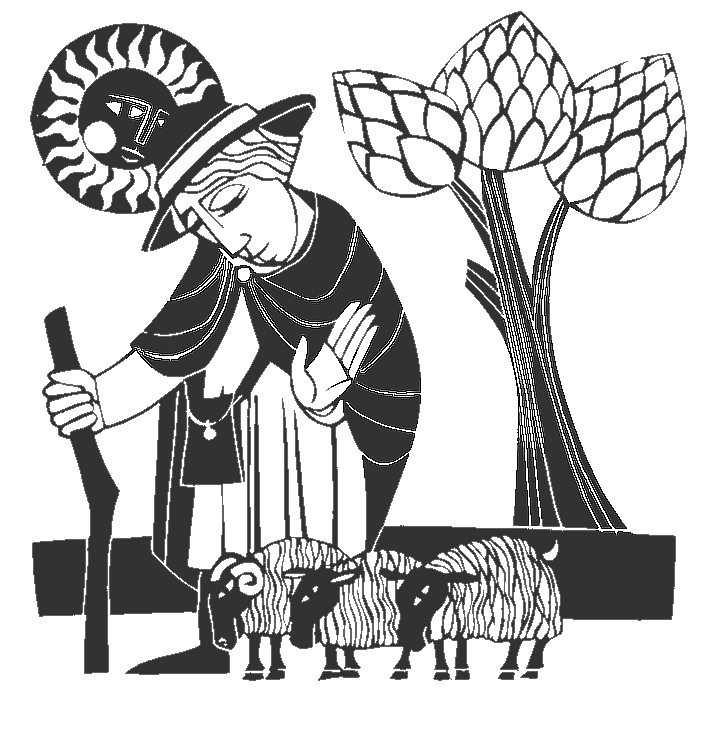
What are some facts about those woolly creatures we call sheep? Jesus talks about them and their shepherds in the Gospel this week.
Well, did you (or I) in our childhood have fun by turning various insects on their backs? Childishly, we would watched them struggle and never achieve their proper leg-side down position, unless we had mercy on them. Shepherds tell us an unshorn sheep is the same way: completely stranded if it gets turned on its back. In order to turn it right-side up when it was in need, the shepherd would carry a “crook” and with it would hook the sheep and turn it right. He was kind and careful.
That was why they followed him.
History tells us that in Jesus’ time the many shepherds all brought their small flocks down to Jerusalem and that they kept these together in one big sheepfold. There were no brands, no markings of any kind, just a fuzzy mob. How, you might ask, would each shepherd retrieve the sheep that belonged to him (or to his boss)?
The first way was by calling each of his sheep by name. He had been with them on the hillsides to the point that they were no longer strangers to him. For instance, there was the one with the nick in its ear, the one with the pretty face, the one that limped. He had a name for each because they each had a personality that was special, just as you and I do today. When they heard their name, they got up and followed.
Second, the sheep recognized not only its name but the actual voice of the shepherd, a much loved sound. It belonged to the one who flipped them back on their feet, the one who shielded them from wolves, the one who led them to fresh pastures instead of what they had eaten down to nubs. A stranger’s voice could not have the gentle consonance of their master and friend.
The appropriate sheep flocked to him.
Why does Jesus use such imagery on the Fourth Sunday of Easter? I suppose you know the answer already, but—if you will pardon the comparison—you and I are much like sheep. The shepherd calls us by name, which means that the magnificent God of the universe pays attention to us. He knows each and every one of us better than we know ourselves. The name he confirms for each of us finds its way down to the deepest interior of our souls. Christ calls each of us by name to be most truly who we are.
Of course, we often mishear such a voice. We ignore it, resist it, button our ears to it. But in our moments of sane and solitary wholeness, or maybe in our times of trouble, our spirits pulse to the rhythm of God’s voice. It resounds within us.
Like the shepherd with his sheep, and in spite of wolves and wildness all around, this call is safe. Christ's call lets our fear drop away; it turns us right side up. It lets us follow our master and friend, around rocks and even through dark valleys.
Sometimes the phrase, “people are sheep,” is deemed an insult. This Sunday it is the greatest compliment we could get.


